

Hypolock®: A Dedicated Connection Concept for Sodium Hypochlorite
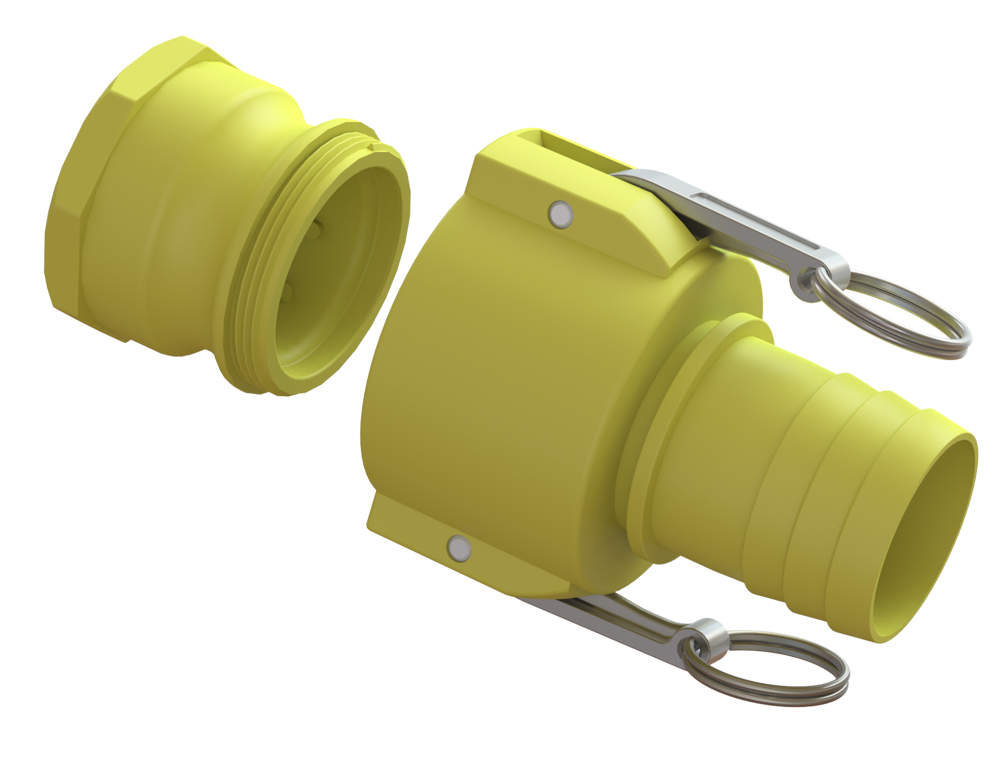
Sodium hypochlorite is widely used in water treatment, cleaning and industrial processes, but it requires careful material selection and disciplined transfer procedures. CPP® developed the Hypolock® concept around one simple idea: a dedicated connection should not accidentally mate with a standard Camlock system.
Why use a non-compatible connection?
Standardised couplings are useful because they interchange. In some chemical duties, however, interchangeability can create the wrong opportunity: a hose intended for one chemical can be connected to equipment carrying another. A deliberately non-compatible connection can form part of a wider segregation strategy.
Designed for a specific chemical duty
Hypolock® is intended for liquid sodium hypochlorite service. The connection geometry is based on the familiar operating principle of a lever-arm coupling while preventing normal Camlock interchangeability.
Material compatibility still matters
A dedicated coupling does not replace chemical-compatibility checks. Body materials, seals, hoses, valves and downstream equipment must all be suitable for the concentration, temperature and operating conditions involved.
Part of a complete transfer procedure
Connection keying is most effective when combined with clear labelling, hose segregation, operator training and documented transfer procedures. The objective is to reduce the chance of an incorrect connection, not to replace normal chemical-handling controls.
Availability and project support
Hypolock® is a specialist CPP® development programme. Contact CPP® to discuss current product availability, sizes and application requirements before specifying it into a system.
Need help with an IBC, Camlock or fluid-transfer connection? Ask CPP® Technical Support or contact CPP®.